


Have any questions?
Have any questions?

The inverted umbrella was designed to solve one specific, everyday annoyance: the wet canopy. A conventional umbrella, when closed, wraps its soaked surface around the outside, so it drips on the car seat, the lift floor and the person standing behind you. A reverse umbrella folds the other way, trapping the water inside the canopy.
That single change in geometry has turned inverted models from a novelty into a standard option for corporate gifts, hotel amenities, car accessories and retail programmes. This guide explains how the mechanism works, what the double-layer canopy and C-shaped handle actually add, and where the format stops making sense. It is written for buyers who need to specify, sample and import these umbrellas rather than just carry one.
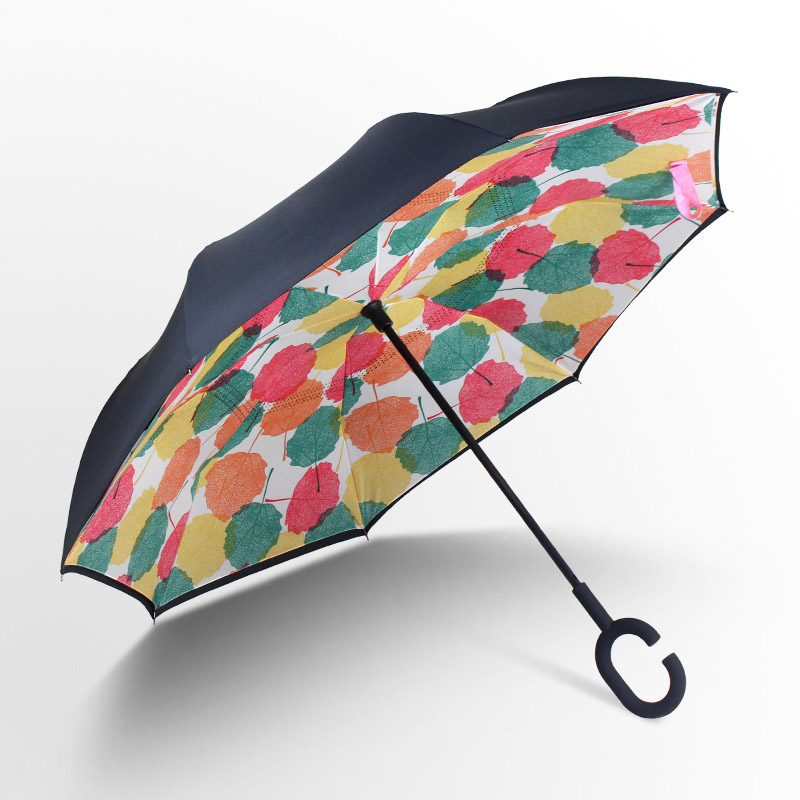
A reverse umbrella opens upward and inward, so the wet surface finishes on the inside of the closed canopy.
On a normal umbrella, the canopy opens upward and closes downward: the ribs fold away from the shaft and the wet fabric ends up on the outside of the bundle. On an inverted umbrella, the canopy opens upward but closes upward as well. The panel structure turns inside out as it collapses, so the dry inner surface becomes the outer surface of the closed umbrella and the wet surface is sealed inside.
The mechanism that makes this possible is a double-layer construction with a reversed runner and a set of ribs that travel past the closed position. It is not a cosmetic variation of a standard frame — the canopy pattern, the rib geometry and the runner all differ.
On an automatic model, the opening is spring-assisted; closing is often semi-automatic, meaning the release is triggered by a button but the final collapse is completed by hand. That is a deliberate design choice: a fully powered close on a canopy this size would need a heavier spring and a stronger runner, which adds weight and cost.
The water is not absorbed by the umbrella — it is physically enclosed. When the canopy collapses inward, the wet face is folded against the wet face of the opposite panel, and the dry face becomes the outside. A closed reverse umbrella can be laid on a car seat, stood in a lobby or put into a bag without leaving a trail.
Two caveats worth knowing before you promise this to a client. First, water is trapped, not evaporated: if the umbrella stays closed and wet for hours, the fabric is still wet when reopened, and it needs to be opened to dry properly. Second, the seal is not absolute at the top notch, where the shaft passes through the canopy. A reverse umbrella is dramatically better than a conventional one in a car, but it is not a sealed container.
Inverted umbrellas are almost always double-layered, and for two reasons. The first is structural: two layers give the canopy enough stiffness to fold inside out repeatedly without the panels losing shape. The second is performance: the double layer improves water resistance, increases wind resistance and, on many models, carries a printed pattern on the inner surface.
Our customized premium double layer inverted umbrella uses a high-density double-layer pongee canopy on a reinforced fibreglass and steel frame, with an optional blue-sky-and-clouds print on the inside. That inner print is the feature most buyers underestimate: when the umbrella opens, the user sees a designed surface, not a grey lining.
Be clear with your supplier about what "double layer" means in their quotation. On some low-cost models it refers to two thin layers laminated together; on better ones it is two separately cut and sewn canopies. The second construction is what delivers the stiffness the inverted mechanism depends on.
A C-shaped handle is an open hook that loops over the wrist or forearm instead of being gripped in the palm. The practical effect is that the hand stays free: you can hold a phone, carry a bag, take a child's hand or unlock a door while the umbrella hangs from your arm.
This is why the format has been adopted so quickly in urban commuting and in car use. It is also why the handle is worth specifying carefully: a moulded plastic C-handle is light and cheap, but the opening must be large enough for a coat sleeve and the inner curve should be smooth rather than ridged, or it becomes uncomfortable after ten minutes.
For corporate gifting, the handle is also a branding surface. Pad printing on the flat outer face of a C-handle is straightforward; printing along the curve is not, and it usually requires a different process.
Getting in and out of a car in the rain is the scenario the format was designed for. The umbrella opens inside the door frame, and once closed it can be placed on the passenger seat or floor without soaking the interior. This is the single strongest selling point for retail packaging and for automotive-branded gift programmes.
A lobby umbrella stand full of dripping conventional umbrellas is a slip hazard and a cleaning cost. Reverse umbrellas reduce both, which is why hospitality buyers specify them for guest loan umbrellas and for staff uniforms.
The mechanism is a talking point, and the inner print gives a brand a second surface to design. For a gift that has to be remembered, a reverse umbrella is a more distinctive object than a standard promotional umbrella at a similar price point.
A reverse canopy is not the best choice for a golf bag: the closing action is upward, and the format is optimised for short urban use rather than hours on an open course. Very large reverse canopies exist, but the mechanism becomes heavier and the advantage diminishes. And if the buyer's only criterion is the lowest possible unit price, a simple single-canopy umbrella will always win.
On a conventional umbrella, the underside of the canopy is a hidden surface. On a reverse umbrella it is the surface the user stares at while walking. That makes the inner print a genuine branding opportunity rather than a decorative extra.
Two production notes. First, the inner surface is usually printed before the layers are joined, so colour and artwork must be approved in the flat state — what looks right flat will stretch slightly once the canopy is tensioned. Second, dark outer fabrics with light inner prints are the most common combination, because the contrast makes the inner design legible; the reverse pairing works but needs a denser inner print to avoid show-through.
For an automatic folding reverse model, our customizable wholesale automatic inverted folding car umbrella uses impact cloth on a 10-rib aluminium frame at roughly 405 g, auto open and semi-automatic close, minimum order 100 pieces. It is the specification most car-accessory and gift programmes start from.
It holds the water inside the folded canopy instead of shedding it, so it will not leave a trail across a floor. It is not hermetically sealed — a little water can escape near the top notch — so treat it as a dramatic improvement rather than an absolute guarantee.
The double layer and reinforced frame help, but the format is optimised for urban use, not for exposed coastal or golf-course conditions. If wind resistance is the primary requirement, a vented double-canopy golf umbrella is the better specification.
Because the canopy has to fold inward past the closed position, which needs more travel than a conventional runner provides. A fully powered close would require a heavier spring and a stronger runner, adding weight and cost. Semi-automatic closing keeps the mechanism manageable.
Yes, and it is one of the main reasons brands choose this format. The inner print is applied before the two layers are joined, so artwork must be approved in the flat state. Full-coverage inner designs usually require sublimation rather than screen printing.
100 pieces per design for our reverse umbrella range. Setup costs for the reversed runner and the canopy pattern make smaller runs uneconomic unless you accept a stock colour and a single-colour print.
Usually yes when closed, because the length is comparable to a folding umbrella. The folded bundle is wider, so a stand with narrow slots may be tight — worth checking before a hotel orders a hundred of them.
If you are weighing a reverse umbrella against a conventional folding model for a gift or retail programme, send us the use case, the target weight and the artwork you have in mind. We will tell you whether the mechanism earns its cost for that audience, and quote against a fixed specification. The full range sits in our inverted umbrella collection.
